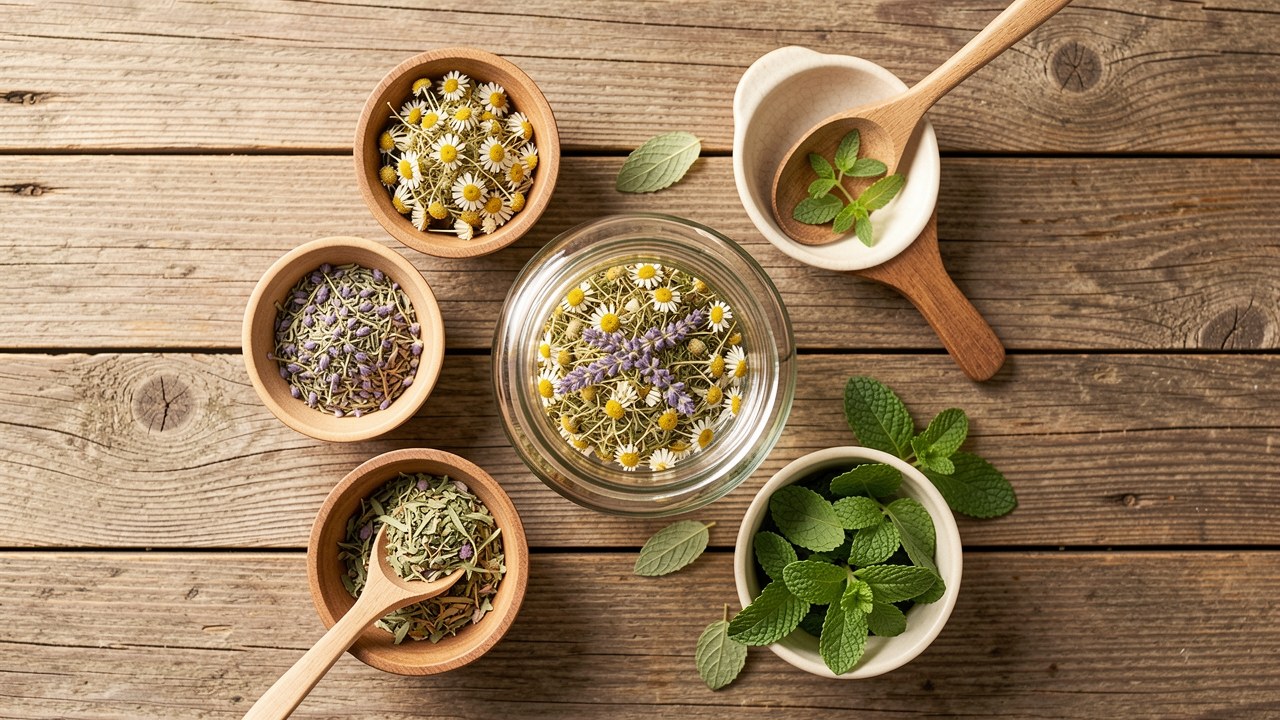
Why blend your own relaxation teas
Blending your own herbal teas lets you tailor flavor and aroma to your preferences while avoiding commercial blends that may contain unwanted additives or excess packaging. It also gives you control over ingredient quality and freshness.
Combining multiple calming herbs is a common approach: some of the best herbal teas blend several botanicals so the cup can address both body and mind. A homemade blend can be adjusted seasonally or to suit what you have on hand.
- Customize flavor: mix herbs you enjoy and omit ones you dislike.
- Control ingredients: choose organic or locally sourced dried herbs.
- Save money: buying dried herbs in bulk is often more economical than pre-made tea bags.
- Create ritual: the process of blending adds a mindful step to your evening routine.
Sources: Sip Herbals
Key herbs for relaxation and how to combine them
Chamomile is one of the most popular herbs for relaxation and has a light, apple-like scent that pairs well in many blends. Lavender is known for its calming aroma and pairs with chamomile, rose, or lemon balm. Lemon balm is a lemony herb that supports relaxation without drowsiness and can be blended for afternoon or evening calm. Peppermint is described as pungent, slightly sweet, and warming with a secondary cooling action, and appears in several relaxation blends. Valerian root is often used in nighttime blends and is described as a stronger herb best enjoyed in the evening; consult a healthcare professional before using it if you are pregnant, nursing, or taking medication.
Pairing suggestions from sources include lavender with chamomile or lemon balm, and chamomile with cardamom for drifting off to sleep. A classic trio combines chamomile and lavender with peppermint for a cooling, mind-clearing taste.
- Chamomile: light, apple-like; pairs with lavender, lemon balm, rose, peppermint.
- Lavender: floral, calming; pairs with chamomile, rose, lemon balm.
- Lemon balm: lemony, gentle; pairs with chamomile, lavender, peppermint.
- Peppermint: pungent, sweet, warming-cooling; pairs with chamomile, lemon balm.
- Valerian root: earthy, strong; often used alone or with other nighttime herbs.
Sources: Wildly Organic, Catalyst Tea Company, Nelson's Tea, Wanderlust
ratios for beginners
A simple framework divides a blend into base herbs, supporting herbs, and accent herbs. Base herbs provide a neutral nourishing foundation—commonly dried leaves like nettle, raspberry leaf, or oatstraw. Supporting herbs add function such as releasing tension—examples include chamomile, lemon balm, or skullcap. Accent herbs are mainly for taste—such as peppermint, rose petals, or lavender.
Typical ratios vary by source. One relaxation blend uses 2 parts chamomile, 2 parts rosehips, 2 parts peppermint, and 1 part lemon balm. Another classic blend uses equal parts holy basil, chamomile, lemon balm, and lavender. A meditation blend uses 1 teaspoon each of nettle leaf, raspberry leaf, oatstraw, catnip, skullcap, and rose petals. Beginners can start with equal parts of two or three herbs, then adjust to taste.
- Choose a base herb (e.g., nettle, raspberry leaf) for body and mild flavor.
- Add one or two supporting herbs (e.g., chamomile, lemon balm) for calming properties.
- Include an accent herb (e.g., peppermint, lavender) for aroma and taste.
- Blend in a bowl and store in an airtight container away from light and heat.
- Start with equal parts of each herb; tweak ratios in future batches.
Sources: Wildly Organic, Mountain Rose Herbs, Food52
Three simple relaxing blend recipes
These recipes are starting points—adjust herb quantities to your taste. Each makes enough for several cups; store leftovers in an airtight container.
Classic Chamomile-Lavender Blend: Combine 2 parts dried chamomile flowers, 1 part dried lavender buds, and 1 part dried peppermint leaves. This trio is known for its calming and cooling qualities. For a single cup, use 1 teaspoon of the blend per 8 ounces of boiling water; steep covered for 5–7 minutes.
Lemon Balm and Mint Soother: Mix equal parts dried lemon balm and dried peppermint. This blend is light and refreshing, suitable for afternoon or early evening. Use 1 teaspoon per cup; steep for 5–10 minutes.
Valerian Root Nightcap: Combine 1 part dried valerian root with 2 parts dried chamomile and 1 part dried lemon balm. Valerian is a stronger herb; use it in the evening and consult a healthcare professional if you are pregnant, nursing, or taking medication. Use 1 teaspoon per cup; steep covered for 10 minutes.
- Classic Chamomile-Lavender Blend: 2 parts chamomile, 1 part lavender, 1 part peppermint.
- Lemon Balm and Mint Soother: equal parts lemon balm and peppermint.
- Valerian Root Nightcap: 1 part valerian root, 2 parts chamomile, 1 part lemon balm.
Sources: Mountain Rose Herbs, Catalyst Tea Company, Nelson's Tea
How to store and preserve your DIY blends
Store dried herb blends in an airtight container, such as a glass jar with a tight-fitting lid, away from direct light, heat, and moisture. A cool, dark cupboard is ideal. Label each container with the blend name and date.
While specific shelf-life guidelines are not provided by the sources, keeping herbs dry and sealed will help maintain flavor and aroma. If a blend smells weak or looks faded, it is likely past its prime. Make small batches to use within a few months.
- Use airtight glass jars; avoid plastic bags that can transfer odors.
- Keep away from sunlight, stove, and dishwasher heat.
- Label with blend name and date.
- Make only as much as you will use in a few months.
Sources: Wildly Organic
steeping tips for best flavor
For loose herbal tea, use about 1 teaspoon of blend per 8 ounces of freshly boiled water, unless a recipe specifies otherwise. One source suggests 2 tablespoons per 8 ounces for a stronger brew. Steeping for at least 5–7 minutes allows the calming oils and nutrients to be released. Keep the mug covered while it brews to hold in aromas.
After steeping, strain the herbs and serve. You can add honey or lemon if desired, but try the tea plain first to appreciate the natural flavors.
- Use 1 teaspoon to 2 tablespoons per cup, depending on desired strength.
- Pour boiling water over herbs and cover.
- Steep 5–10 minutes; longer for roots like valerian.
- Strain and serve warm.
Sources: Wildly Organic, Nelson's Tea
Troubleshooting: fixing flavor issues and making substitutions
If your blend tastes too bitter, reduce the amount of strong herbs like valerian or steep for a shorter time. If it lacks flavor, increase the proportion of accent herbs such as peppermint or lavender, or use a bit more blend per cup.
If you dislike a particular herb, swap it for one with a similar role. For example, replace lemon balm with lemon verbena or chamomile with another gentle base herb. When substituting, start with small amounts and adjust. For caffeine-free blends, avoid true tea leaves (Camellia sinensis) and stick to herbs.
- Too bitter: shorten steeping time or reduce strong herbs.
- Too weak: add more accent herbs or increase blend quantity.
- Substitute: match role (base, supporting, accent) and adjust gradually.
- Avoid caffeine: use only herbal ingredients.
Sources: Mountain Rose Herbs, Catalyst Tea Company
Frequently asked questions
What are the best herbs for a homemade relaxation tea blend?
Chamomile, lavender, lemon balm, and peppermint are commonly used. Valerian root is also popular for evening blends but is stronger and should be used with caution. These herbs are often combined to address both body and mind.
Sources: Catalyst Tea Company, Nelson's Tea, Sip HerbalsHow much of each herb should I use in a blend?
Ratios vary. A common starting point is equal parts of two or three herbs. One relaxation recipe uses 2 parts chamomile, 2 parts rosehips, 2 parts peppermint, and 1 part lemon balm. Another uses equal parts holy basil, chamomile, lemon balm, and lavender. Adjust to taste.
Sources: Wildly Organic, Food52Can I use fresh herbs instead of dried in my blends?
Dried herbs are typically recommended for blends because they have a longer shelf life and more concentrated flavor. Fresh herbs contain moisture and can spoil quickly; if you use them, consume the blend within a few days and store it in the refrigerator.
Sources: Wildly OrganicHow long do homemade tea blends stay fresh?
Specific shelf-life times are not provided by the sources, but dried herbs generally keep best when stored in an airtight container away from light and heat. Aim to use your blend within a few months for optimal flavor.
Sources: Wildly OrganicWhat herbs should I avoid if I'm pregnant or on medication?
Consult a qualified healthcare professional before using any herbal blend, especially if you are pregnant, nursing, or taking medication. Valerian root, in particular, is described as a stronger herb and should be used only under professional guidance in these situations.
Sources: Catalyst Tea CompanyCan I mix any calming herbs together?
Many calming herbs can be combined, but it's wise to start with small amounts and research each herb. Some herbs may interact with medications or have contraindications. Stick to well-known combinations like chamomile with lavender or lemon balm.
Sources: Catalyst Tea Company, Sip HerbalsDo I need to use dried herbs for blending?
Dried herbs are preferred because they are more concentrated, have a longer shelf life, and are easier to measure consistently. If you use fresh herbs, use them promptly and adjust quantities since they contain water.
Sources: Wildly OrganicHow long do homemade tea blends last?
There is no single authoritative duration, but for best quality, keep blends in an airtight container in a cool, dark place and use within a few months. aroma and flavor will gradually fade over time.
Sources: Wildly OrganicSources
- DIY Herbal Tea Blend For Relaxation — Wildly Organic
- Herbal Tea Blend Recipe For Meditation — Mountain Rose Herbs
- How to Make Your Own Herbal Tea Blend - Food52 — Food52
- How to Choose Herbal Teas for Body and Mind Relaxation — Catalyst Tea Company
- Herbal Tea Blend Recipe For Meditation — Nelson's Tea
- 5 Best Herbal Teas for Relaxation and Calm - Sip Herbals Blog — Sip Herbals
- 10 Organic Herbal Tea Combinations for Every Ailment | Wanderlust — Wanderlust