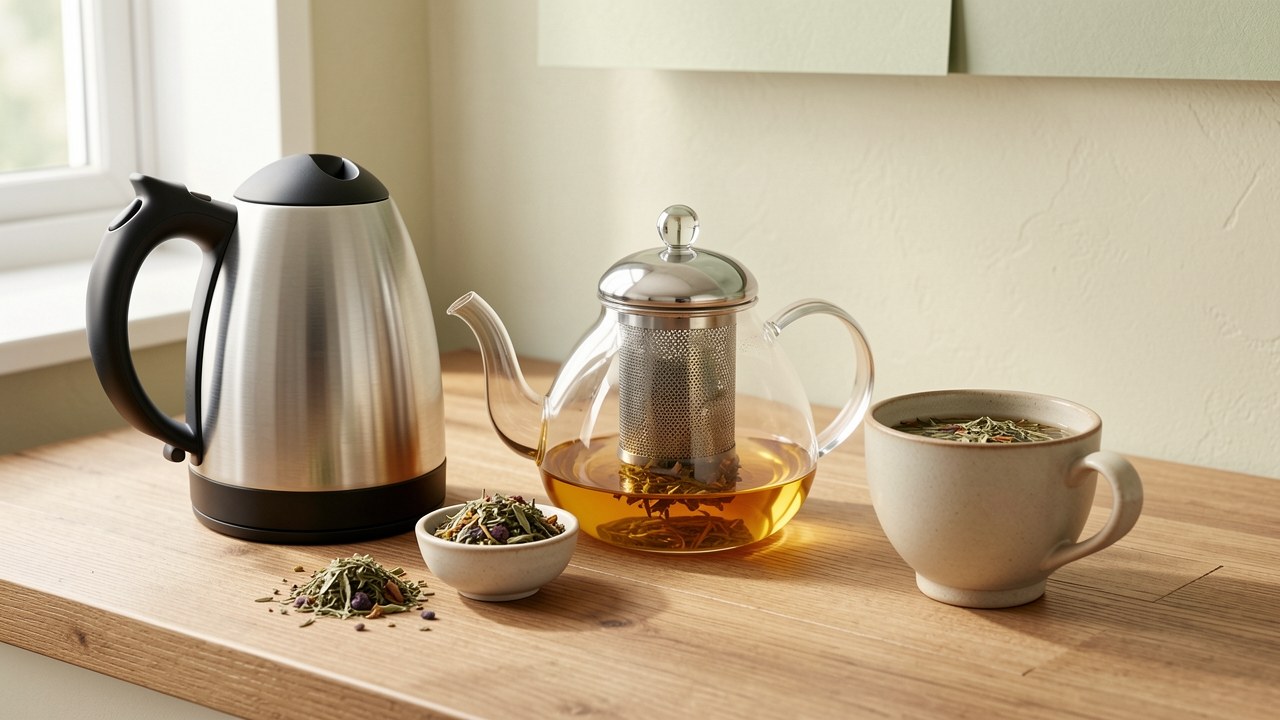
Why brewing method matters for herbal tea quality
Herbal tea is not made from the tea plant, so it behaves differently from green, black, or oolong tea. The leaves, flowers, roots, and seeds used in herbal blends release their flavor and aroma at different rates depending on water temperature, steeping time, and how much plant material you use. These variables directly affect the quality of the final cup: whether it tastes full and clean or weak, harsh, or muddy.
Unlike true teas, many herbal ingredients are brewed with fully boiling water. Most garden herbs such as mint, lemon balm, lemon verbena, lemongrass, thyme, and sage are brewed with fully boiling water at 212°F. Delicate flowers and herbs such as chamomile, lavender, rose petals, calendula, rosemary, and citrus peel are often brewed with water that has cooled slightly, around 185–195°F. That small difference helps preserve the fragile aromatics that make those herbs pleasant.
Steeping time matters just as much. Most garden herbs are steeped for about 5 minutes, while delicate herbs such as chamomile, lavender, rose petals, rosemary, and citrus peel steep for about 3 minutes. Leaving the herbs in the water longer than intended can pull out bitter compounds, especially from delicate flowers. Removing the tea from the leaves immediately after steeping is a simple rule that prevents that drift toward bitterness.
- Boiling water (212°F) suits most garden herbs: mint, lemon balm, lemon verbena, lemongrass, thyme, sage.
- Slightly cooler water (185–195°F) suits delicate flowers and herbs: chamomile, lavender, rose petals, calendula, rosemary, citrus peel.
- Most garden herbs steep about 5 minutes; delicate herbs steep about 3 minutes.
- Remove the herbs from the water when the steep is done to avoid bitterness.
Sources: University of Illinois Extension, Buddha Teas
What you need: equipment for loose leaf and bags
You do not need much to brew a good cup of herbal tea. The basic equipment is a heatproof vessel, a way to contain or strain the plant material, and a kettle or pot to heat water. What changes between methods is how the tea and water meet, and how easy it is to remove the herbs when the steep is finished.
For loose-leaf tea, common options include a teapot, a single-serving strainer or tea ball, a paper filter, and an infuser basket. A teapot works well when you are making several cups at once, and it lets the leaves circulate freely. A strainer, tea ball, or paper filter fits over a mug and is simple for one cup. An infuser basket sits inside the mug or pot and is lifted out when the steep is done. Each has trade-offs in how much the leaves expand and how quickly you can stop the extraction.
For tea bags, the bag itself is the strainer. You need only a mug and hot water. Bags are convenient and consistent, though they generally use smaller pieces of plant material and may extract faster than whole loose leaves. If you want to move between methods, a teapot or a mug with a removable infuser basket covers most situations.
- Teapot: good for multiple cups; leaves circulate freely.
- Single-serving strainer, tea ball, or paper filter: fits over a mug; good for one cup.
- Infuser basket: sits in the mug or pot; lift out to stop steeping.
- Tea bags: no extra equipment needed; the bag acts as the strainer.
Sources: Buddha Teas, Simple Loose Leaf
Water temperature and how to estimate without a thermometer
Water temperature is a major lever on flavor. Most herbal teas are brewed with fully boiling water at 212°F. For delicate flowers and herbs, letting boiling water sit for one to two minutes first brings it down to roughly 185–195°F. That short pause is often enough to protect fragile aromatics without under-extracting the herbs.
If you do not have a thermometer, visual cues can help. A full rolling boil indicates 212°F. As the water cools, the bubbles become smaller and less vigorous. Small bubbles forming on the bottom and sides of the pot suggest a lower temperature. This is not precise, but it is a practical way to estimate when the water has cooled enough for delicate herbs.
- 212°F: full rolling boil.
- 185–195°F: let boiling water sit 1–2 minutes.
- Small bubbles forming: visual cue for cooler water.
- Full rolling boil: visual cue for 212°F.
Sources: University of Illinois Extension, Buddha Teas
Steeping times for common relaxing herbs
Steeping times vary by herb and by the form of the herb. Published recommendations differ, so the table below shows the ranges reported by the sources used for this guide rather than a single fixed rule. Use these as starting points and adjust to taste.
For most garden herbs, about 5 minutes is a reasonable starting point. Delicate herbs such as chamomile, lavender, rose petals, rosemary, and citrus peel are often ready at about 3 minutes. Some general herbal tea guides recommend 5–7 minutes, and single-serving methods sometimes suggest 5–10 minutes. The differences reflect the fact that these are recommendations from practitioners and retailers, not standardized laboratory protocols.
Valerian root is sometimes included in relaxing blends, but the sources used here do not provide a specific steeping time for it. If you are using a blend that contains valerian, follow the guidance on the package or a trusted herbal reference. Because valerian is a stronger herb, it is worth being conservative the first time you brew it.
| Herb or method | Water temperature | Steeping time | Source note |
|---|---|---|---|
| Most garden herbs (mint, lemon balm, lemon verbena, lemongrass, thyme, sage) | 212°F | About 5 minutes | |
| Delicate herbs (chamomile, lavender, rose petals, calendula, rosemary, citrus peel) | 185–195°F | About 3 minutes | |
| General herbal tea | 212°F | 5–7 minutes | |
| Teapot method | 212°F | 3–5 minutes | |
| Single-serving method | 212°F | 5–10 minutes | |
| Hot herbal tea baseline | Not specified | 3–5 minutes |
Sources: University of Illinois Extension, Buddha Teas, Simple Loose Leaf, Summer Stirs
How much tea to use: leaf-to-water ratio
The amount of herbal tea you use depends on whether you are measuring dried or fresh herbs and whether you are using a teaspoon or tablespoon as your unit. The sources used here give different starting points, so it helps to know the range and then adjust.
One common loose-leaf ratio is 1 teaspoon per 8-ounce cup of water. For a teapot, some guides add an extra spoonful “for the pot.” A different approach measures dried herbs in tablespoons: 1–2 tablespoons per cup of water, with fresh herbs used at roughly three times the dried amount (3–5 tablespoons per cup). That is a substantial difference in quantity, and it reflects the fact that herbal teas are often brewed stronger than true teas.
For cold-brewed herbal tea, one source recommends about 1 tablespoon of herbal tea per 12 ounces (1.5 cups) of unheated water. That is a different ratio again, because cold water extracts more slowly and the tea sits for hours.
The practical takeaway is to start with one of these ratios, taste the result, and adjust. If the cup is too weak, add more tea or steep a little longer. If it is too strong or bitter, use less tea or shorten the steep.
- 1 teaspoon per 8-ounce cup is a common loose-leaf starting point.
- For a teapot, add an extra spoonful “for the pot.”
- 1–2 tablespoons dried herb per cup is another reported range.
- Fresh herbs: use roughly three times the dried amount (3–5 tablespoons per cup).
- Cold brew: about 1 tablespoon per 12 ounces (1.5 cups) of unheated water.
Sources: University of Illinois Extension, Buddha Teas, Simple Loose Leaf, Summer Stirs
Step-by-step brewing instructions
The following sequence works for most hot-brewed herbal teas, whether you are using loose leaves or a tea bag. It assumes you are brewing one to two cups. Adjust quantities for a larger pot.
The key moments are heating the water to the right temperature, adding the tea, timing the steep, and removing the tea when the time is up. If you are using a tea bag, step 2 is simply placing the bag in the mug. If you are using a teapot, you can strain into cups at the end.
- Heat fresh, cold water. For most garden herbs, bring it to a full rolling boil (212°F). For delicate flowers and herbs, let it sit 1–2 minutes after boiling to reach about 185–195°F.
- Measure your tea. For loose-leaf, use about 1 teaspoon per 8-ounce cup, or 1–2 tablespoons dried herb per cup, depending on the strength you want. For fresh herbs, use about three times the dried amount. If you are using a tea bag, place one bag in your mug.
- Place the tea in your brewing vessel. Use a teapot, infuser basket, strainer, tea ball, or paper filter for loose-leaf. For a tea bag, the bag goes directly into the mug.
- Pour the heated water over the tea. Make sure the plant material is fully submerged and has room to circulate.
- Cover and steep. Most garden herbs steep about 5 minutes. Delicate herbs steep about 3 minutes. Some general guides suggest 5–7 minutes, and single-serving methods sometimes suggest 5–10 minutes. Start with the shorter time for delicate herbs and the longer time for roots and tougher plant material.
- Remove the tea from the water. Lift out the infuser basket, strain the teapot, or take out the tea bag. Removing the tea promptly helps prevent bitterness.
- Taste and adjust. If the cup is too weak, steep a little longer next time or add more tea. If it is too bitter, shorten the steep or use cooler water for delicate herbs.
- Serve and enjoy. Herbal tea is usually drunk warm, but you can let it cool if you prefer.
Sources: University of Illinois Extension, Buddha Teas, Simple Loose Leaf, Summer Stirs
Troubleshooting: weak tea, bitter tea, and cloudy brew
Three problems come up often when brewing herbal tea: the cup tastes weak, the cup tastes bitter, or the liquid looks cloudy. Each has a straightforward cause and a simple fix.
Weak tea usually means not enough tea, not enough time, or water that was not hot enough for the herb you used. If you used delicate herbs with fully boiling water and a short steep, the flavor may be thin. Try increasing the amount of tea or steeping a little longer. For roots and tougher plant material, make sure the water is at a full boil.
Cloudy brew can come from fine particles in the tea or from the minerals in your water. If you are using loose-leaf tea with a lot of dust or broken pieces, a finer strainer or a paper filter can help. If your water is hard, a different water source may give a clearer cup. Cloudiness is usually a cosmetic issue rather than a flavor problem, but if it bothers you, try filtering the tea or using bottled water.
- Weak tea: use more tea, steep longer, or make sure water is hot enough for the herb.
- Bitter tea: remove the tea promptly after steeping; try a shorter steep or cooler water for delicate herbs.
- Cloudy brew: use a finer strainer, paper filter, or different water source.
- Taste as you go and adjust one variable at a time.
Sources: University of Illinois Extension, Buddha Teas
Brewing loose-leaf tea with an infuser basket
An infuser basket is one of the easiest ways to brew loose-leaf herbal tea. The basket sits inside your mug or teapot, holds the leaves, and lifts out when the steep is done. This makes it simple to stop the extraction at the right moment.
To use an infuser basket, place the measured tea in the basket and set it in your mug. Heat the water to the temperature appropriate for your herb, pour it over the tea, and cover. Steep for the recommended time—about 5 minutes for most garden herbs, about 3 minutes for delicate flowers. When the time is up, lift the basket out and let it drain. Your tea is ready.
One advantage of a basket is that the leaves have room to expand and circulate, which can give a fuller flavor than a tightly packed tea ball. Choose a basket with fine enough mesh to contain small pieces, and rinse it promptly after use to prevent staining and stale odors.
- Place the measured loose-leaf tea in the infuser basket.
- Set the basket in your mug or teapot.
- Heat water to the appropriate temperature: 212°F for most garden herbs, or let boiling water sit 1–2 minutes for delicate herbs.
- Pour the water over the tea, making sure the leaves are submerged.
- Cover and steep: about 5 minutes for most garden herbs, about 3 minutes for delicate flowers.
- Lift out the basket and let it drain.
- Taste and adjust as needed.
Sources: University of Illinois Extension, Buddha Teas, Simple Loose Leaf
Using a French press for herbal tea
A French press is essentially a tall carafe with a plunger and a mesh filter. It works well for herbal tea because it gives the leaves plenty of room to circulate, and the plunger strains the tea when you are ready to pour. It is a good option when you want to brew several cups at once without transferring the tea to another vessel.
The method is similar to other loose-leaf brewing. Add the measured tea to the carafe, pour in heated water, and let it steep. When the time is up, press the plunger down slowly to trap the plant material at the bottom. Pour the tea into your cup. The main caveat is that the tea continues to sit with the leaves, so if you do not drink it all at once, the later cups may become stronger or more bitter. If you want to avoid that, pour the entire brew into a separate pitcher or thermos after pressing.
The sources used for this guide do not give a specific French press ratio or time, so start with the general recommendations: about 1 teaspoon per 8-ounce cup, or 1–2 tablespoons dried herb per cup, and steep about 5 minutes for most garden herbs or about 3 minutes for delicate flowers. Adjust from there.
- Add measured tea to the French press carafe.
- Pour heated water over the tea and stir gently.
- Steep: about 5 minutes for most garden herbs, about 3 minutes for delicate flowers.
- Press the plunger down slowly.
- Pour into cups; if you will not drink it all, transfer the tea to another vessel to stop extraction.
Sources: University of Illinois Extension, Buddha Teas, Simple Loose Leaf
Brewing tea bags: quick and convenient
Tea bags are the simplest way to brew herbal tea. The bag acts as its own strainer, so you need only a mug and hot water. Bags are convenient and consistent, and they are a good choice when you are in a hurry or do not want to measure loose leaves.
To brew a tea bag, place the bag in your mug and pour heated water over it. Use 212°F for most garden herbs, or let boiling water sit 1–2 minutes for delicate herbs. Steep for the time recommended for the herb. Most garden herbs steep about 5 minutes; delicate herbs steep about 3 minutes. When the time is up, lift out the bag and let it drain. Do not squeeze the bag unless you want a stronger, possibly more bitter cup, because squeezing can release fine particles and harsh compounds.
One practical difference between bags and loose leaves is that bags often contain smaller pieces of plant material, which can extract faster. If your tea tastes too strong or bitter, try a shorter steep next time. If it tastes weak, steep a little longer or use two bags.
- Place the tea bag in your mug.
- Heat water: 212°F for most garden herbs, or let boiling water sit 1–2 minutes for delicate herbs.
- Pour water over the bag.
- Steep about 5 minutes for most garden herbs, about 3 minutes for delicate herbs.
- Remove the bag without squeezing to avoid bitterness.
Sources: University of Illinois Extension, Buddha Teas, Simple Loose Leaf, Summer Stirs
Cold brew method for herbal teas
Cold brewing is a gentle, slow method that produces a different flavor profile from hot-steeped tea. One source notes that cold-brewed herbal tea generally has a slightly different, more well-rounded flavor profile than hot-steeped tea, with more delicate herbal flavors coming forward. It is a good option for warm weather or for herbs that can turn bitter with heat.
For cold-brewed herbal tea, one source recommends about 1 tablespoon of herbal tea per 12 ounces (1.5 cups) of unheated water. Combine the tea and water in a clean glass jar or pitcher, cover, and refrigerate. Let it steep for several hours or overnight, then strain out the plant material. The exact time is flexible, but longer steeping gives a stronger flavor. Because cold water extracts more slowly, you can leave it overnight without the same risk of bitterness that comes with over-steeping hot water.
Sun tea is a related method. One source describes making sun tea in a clear glass container with cold water and 1–2 tablespoons of herbs per 16 ounces, left in direct sunlight for 3–4 hours or overnight, then strained. As with any cold infusion, keep the container clean and refrigerate the finished tea if you are not drinking it right away.
- Use about 1 tablespoon of herbal tea per 12 ounces (1.5 cups) of unheated water for cold brew.
- Combine tea and water in a clean jar or pitcher, cover, and refrigerate.
- Steep several hours or overnight, then strain.
- Sun tea: 1–2 tablespoons of herbs per 16 ounces of cold water, in direct sunlight 3–4 hours or overnight, then strain.
Sources: Simple Loose Leaf, Summer Stirs
Cleaning and maintaining your brewing equipment
Clean equipment keeps your tea tasting fresh and helps your gear last. The basic routine is simple: rinse your teapot, infuser basket, strainer, tea ball, or French press with hot water immediately after each use, and wash with mild soap when needed. Rinse thoroughly so no soap residue remains.
Stains and odors are the main issues. Tea can leave a brown film on the inside of teapots and baskets, especially with darker herbs. A paste of baking soda and water, or a soak in a mixture of water and white vinegar, can help lift stains and odors. Rinse well afterward. For mesh strainers and infuser baskets, a soft brush helps dislodge fine particles that can clog the mesh.
If you use a French press for tea, take it apart and clean the plunger and mesh filter thoroughly, since fine plant material can get trapped between the layers. Allow all equipment to air-dry completely before storing it, especially if it has tight-fitting parts. The sources used for this guide do not provide specific cleaning instructions, so these are general practices rather than recommendations from the cited sources.
- Rinse with hot water after each use; wash with mild soap when needed.
- Remove stains with a baking soda paste or a water-and-vinegar soak.
- Use a soft brush for mesh strainers and infuser baskets.
- Air-dry completely before storing.
Factors to adjust: water temperature, steeping time, and leaf-to-water ratio
Once you understand the three main variables, you can adjust any cup to suit your taste. Water temperature affects which compounds are extracted and how quickly. Steeping time controls how far the extraction goes. Leaf-to-water ratio sets the overall strength. Changing one variable at a time makes it easier to learn what you prefer.
If your tea is too weak, increase the amount of tea or steep a little longer. If it is too bitter, shorten the steep or use cooler water for delicate herbs. If it is too strong but not bitter, use less tea or more water. If you want a more well-rounded, delicate flavor, try cold brewing. If you want a stronger, more immediate cup, use fully boiling water and a longer steep for tougher plant material.
Published recommendations for the same herbs differ. One source gives 1–2 tablespoons dried herb per cup and 3–5 minutes, with 3 minutes for delicate herbs. Another gives 1 teaspoon per 8 ounces and 5–7 minutes for herbal tea. A third gives 1 teaspoon per 8 ounces, 3–5 minutes in a teapot, or 5–10 minutes single-serving. A fourth gives 1 teaspoon per 8 ounces with 3–5 minutes for hot tea, or 1 tablespoon per 12 ounces for cold brew. These are all starting points, not fixed rules. Your own taste is the final judge.
- Weak tea: add more tea or steep longer.
- Bitter tea: shorten the steep or use cooler water for delicate herbs.
- Too strong: use less tea or more water.
- Want a gentler cup: try cold brewing.
- Adjust one variable at a time.
Sources: University of Illinois Extension, Buddha Teas, Simple Loose Leaf, Summer Stirs
Frequently asked questions
Should I boil water or use cooler water for herbal tea?
It depends on the herb. Most garden herbs such as mint, lemon balm, lemon verbena, lemongrass, thyme, and sage are brewed with fully boiling water at 212°F. Delicate flowers and herbs such as chamomile, lavender, rose petals, calendula, rosemary, and citrus peel are often brewed with water that has cooled slightly. A practical method is to boil the water and then let it sit for one to two minutes, which brings it to roughly 185–195°F.
Sources: University of Illinois ExtensionHow long should I steep chamomile tea?
Chamomile is a delicate flower, and one source recommends steeping delicate herbs like chamomile for about 3 minutes. Other general herbal tea guides suggest longer times, such as 5–7 minutes. Start with about 3 minutes and taste. If it is too weak, steep a little longer next time. If it turns bitter, shorten the steep.
Sources: University of Illinois Extension, Buddha TeasHow much loose leaf tea should I use per cup?
A common starting point is 1 teaspoon per 8-ounce cup. Another reported range is 1–2 tablespoons of dried herb per cup, with fresh herbs used at roughly three times the dried amount (3–5 tablespoons per cup). These are different approaches, so start with one and adjust to taste. If the cup is weak, add more tea; if it is too strong, use less.
Sources: University of Illinois Extension, Buddha Teas, Simple Loose Leaf, Summer StirsWhat is the best water temperature for brewing herbal tea?
For most garden herbs, 212°F (fully boiling water) is recommended. For delicate flowers and herbs such as chamomile, lavender, rose petals, calendula, rosemary, and citrus peel, a temperature around 185–195°F is often used. You can reach that range by boiling water and letting it sit for one to two minutes before pouring.
Sources: University of Illinois ExtensionHow long should I steep herbal tea?
Reported steeping times vary. One source recommends about 5 minutes for most garden herbs and about 3 minutes for delicate herbs. Another recommends 5–7 minutes for herbal tea. A third suggests 3–5 minutes in a teapot or 5–10 minutes for a single serving. A fourth gives a baseline of 3–5 minutes for hot herbal tea. Start with the shorter time for delicate herbs and the longer time for roots and tougher plant material, then adjust to taste.
Sources: University of Illinois Extension, Buddha Teas, Simple Loose Leaf, Summer StirsSources
- Herbal teas for relaxation | ILRiverHort | Illinois Extension | Illinois — University of Illinois Extension
- Tea Brewing Guide | How to Brew Loose Leaf & Herbal Tea — Buddha Teas
- How to Brew Herbal Tea – Simple Loose Leaf — Simple Loose Leaf
- How Long Should Herbal Tea Steep? [2026] — Summer Stirs