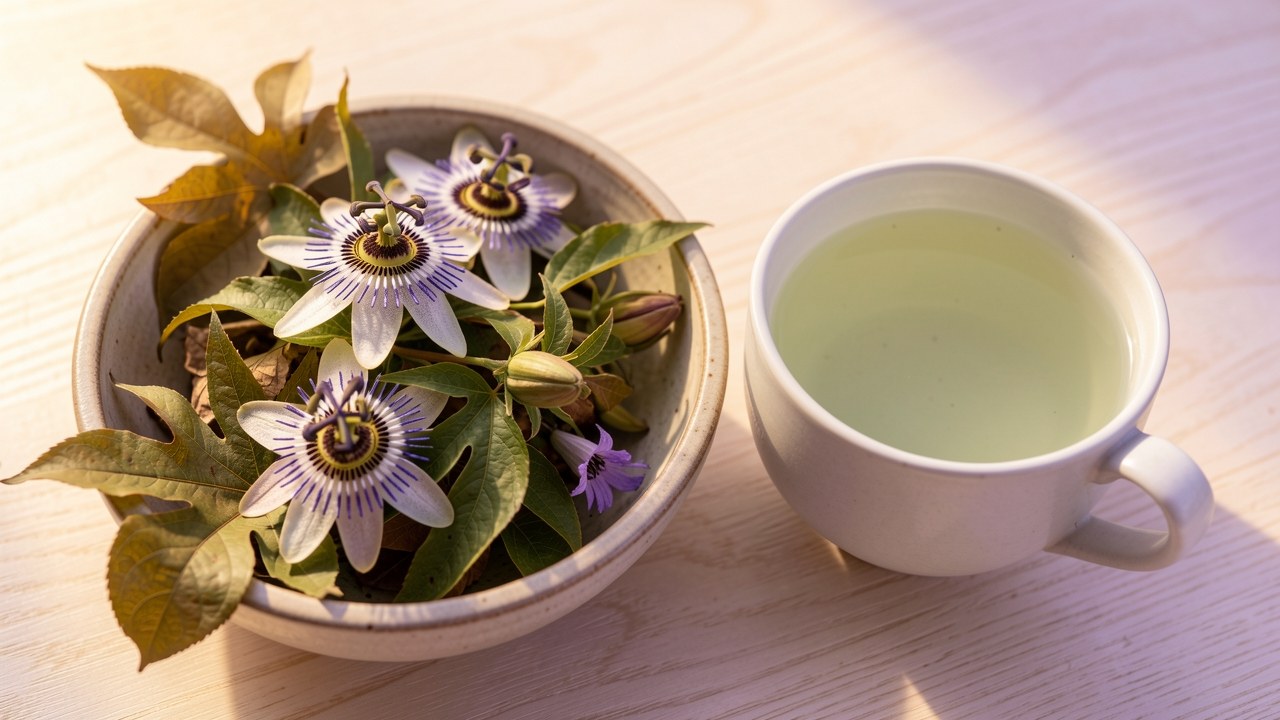
What is passionflower tea
Passionflower tea is an infusion made from the dried leaves, stems, and sometimes flowers of Passiflora incarnata, a climbing vine native to the southeastern United States and parts of Central and South America. The plant is also known as maypop, apricot vine, maracuja, and water lemon.
People brew it as a mild evening drink, usually with the goal of feeling calmer or settling into sleep more easily. It is not the same as the passion fruit you eat: the fruit comes from related species, while the tea traditionally comes from the leaves and flowering tops.
- Botanical name: Passiflora incarnata
- Common names: maypop, apricot vine, maracuja, water lemon
- Plant part typically used: dried leaves and stems, sometimes flowers
- Usual role: a mild calming herb taken in the evening
Sources: National Center for Complementary and Integrative Health (NCCIH), U.S. National Institutes of Health, MedicineNet (medically reviewed by Dr. Raja Durai Sam Nishanth, MBBS, MD)
Traditional uses for relaxation and sleep
Passionflower has been used as a sedative in folk medicine for centuries. According to the National Center for Complementary and Integrative Health, Spanish explorers in South America learned about the plant and brought it to Europe, where it was adopted into European folk medicine.
That traditional reputation is the main reason passionflower tea is still sold as a relaxation and sleep herb today. Traditional use is not the same as proven effect, though. It tells us the plant has a long history of being used this way, not that modern trials have confirmed a consistent benefit.
Some sources also describe the alkaloids harman and harmaline in passionflower as acting somewhat like MAO inhibitors and stimulating the uterus in isolation. Whether the whole plant has those effects in people is not known, so this is a research question rather than a practical description of what the tea does.
- Used historically as a mild sedative
- Brought to Europe from South America by Spanish explorers
- Adopted into European and North American folk medicine
- Still popular today as an evening tea
Sources: National Center for Complementary and Integrative Health (NCCIH), U.S. National Institutes of Health, EBSCO Research Starters (EBSCO CAM Review Board)
What research suggests about passionflower for sleep
The evidence for passionflower tea as a sleep aid is interesting but small. NCCIH reports that a small amount of research suggests oral passionflower might improve total sleep time in adults with insomnia, but that its effects on how quickly people fall asleep and how well they stay asleep are mixed. That is the central finding worth remembering: passionflower is not a proven sleep treatment.
One often-cited study found that drinking passionflower herbal tea each evening for seven days was linked to significantly better reported sleep quality, with limited effects for people who started with low anxiety. Another small two-week trial in 84 participants aged 30 to 52 found that 60 mg of passionflower extract improved sleep compared with placebo in people with insomnia disorder. These are subjective and small studies, so treat the results as suggestive rather than settled.
NCCIH also notes that research on passionflower for anxiety is limited. A small amount of evidence suggests oral passionflower might reduce anxiety, including anxiety before a surgical or dental procedure, but the conclusions are not definite. There is not enough evidence to say whether passionflower helps ADHD, congestive heart failure, menopausal symptoms, fibromyalgia, or general stress.
How it might work is not fully understood either. WebMD notes that passionflower contains chemicals that bind GABA receptors in the brain, which may help reduce anxiety and increase drowsiness. That is a plausible mechanism, not proof that a cup of tea will make you sleepy.
- Small research suggests possible improvement in total sleep time in adults with insomnia
- Effects on falling asleep and staying asleep are mixed
- A seven-day tea study reported better subjective sleep quality, with weaker effects in low-anxiety participants
- A small 60 mg extract trial reported improved sleep versus placebo
- Anxiety evidence is limited and not definitive
- Not enough evidence for ADHD, heart failure, menopause, fibromyalgia or stress
- GABA receptor binding is a possible mechanism, not a proven pathway for tea
Sources: National Center for Complementary and Integrative Health (NCCIH), U.S. National Institutes of Health, Verywell Health, WebMD (reviewed by Chelsey McIntyre, PharmD; Beth Johnston, BCPS, PharmD)
How to brew passionflower tea
Passionflower tea is simple to prepare, and most guidance converges on a short steep of dried herb. MedicineNet, a medically reviewed consumer health source, describes steeping dried herb or a tea bag in boiling water for 6 to 15 minutes depending on how strong you want it. EBSCO's reference entry describes a therapeutic tea frame of 1 cup three times daily, made by steeping 1 teaspoon of dried leaves for ten to fifteen minutes.
MedicineNet suggests 1 to 2 cups per day and notes that for sleep it is often taken an hour or two before bed. Examine notes that in one study passionflower tea was used at 2 grams of dried leaves steeped in hot water daily, and that the study author considered this relatively low and three daily doses impractical because of daytime sedation risk.
Because these are reference frames rather than personalized advice, use them to understand common practice, not as a prescription. If you take medication or have a health condition, talk with a clinician before making passionflower tea a regular habit.
- Measure about 1 teaspoon of dried passionflower leaves, or use one tea bag.
- Heat water to a boil and pour it over the herb.
- Cover the cup and steep for 6 to 15 minutes, depending on how strong you want the tea.
- Strain the leaves, or remove the tea bag, and drink warm.
- If you are using it for sleep, many people drink it an hour or two before bed.
Sources: EBSCO Research Starters (EBSCO CAM Review Board), MedicineNet (medically reviewed by Dr. Raja Durai Sam Nishanth, MBBS, MD), Examine.com
Taste profile and blending ideas
Passionflower tea has a mild flavor with grassy and earthy notes. It is not a strongly perfumed or fruity tea, and a lot of people find it easy to drink plain. MedicineNet notes that it can be sweetened with honey or combined with other relaxation herbs.
Because the flavor is gentle, passionflower blends well. Nonprofit and consumer guides often pair it with lemon balm, chamomile, or lavender for evening use. Those combinations are practical folk practice rather than clinically established blends, and the same guides commonly caution against combining passionflower with a strong sedative such as valerian. If you are already taking a sedative medication, adding multiple calming herbs is a decision to discuss with a clinician rather than a casual experiment.
One common complaint is bitterness. A shorter steep and a slightly lower water temperature can reduce the bitter edge, and a small amount of honey helps mask it. If your tea still tastes harsh, the leaves may be old or finely broken, which releases more bitter compounds.
- Mild, grassy, earthy flavor
- Can be sweetened with honey
- Often blended with lemon balm, chamomile, or lavender
- A shorter steep can reduce bitterness
- Combining with strong sedatives is commonly cautioned against by consumer guides
Sources: MedicineNet (medically reviewed by Dr. Raja Durai Sam Nishanth, MBBS, MD), CAAGe
Safety, side effects, and interactions
Passionflower is generally described as well tolerated at typical tea amounts, but it is not risk-free. NCCIH states that passionflower may be safe as a tea for up to 7 nights and that daily passionflower extract may be safe for up to 8 weeks. Possible side effects include drowsiness, dizziness, and confusion.
The most important interaction warning concerns sedation. WebMD, a pharmacist-reviewed supplement monograph, lists medicines that cause drowsiness, barbiturates, benzodiazepines, muscle relaxants, and opioids as drug classes that may interact with passionflower. EBSCO states that passionflower may exaggerate the effect of sedative medications and that people taking sedatives should use it only under a physician's advice. WebMD also warns that alcohol alongside passionflower may increase the risk of dizziness, drowsiness, and confusion.
NCCIH advises talking to a health care provider if passionflower is used within 2 weeks of scheduled surgery, because it may interact with anesthesia and other perioperative medications. Examine notes a theoretical mechanism by which passionflower may induce CYP3A4, potentially altering blood levels of medications metabolized by that enzyme, though the severity is unknown. Examine also reports a single case study of prolonged QT interval and nonsustained ventricular tachycardia after passionflower supplementation and advises caution for people with a history of heart arrhythmias; that is a precaution flagged by an evidence review, not an established causal risk.
Some populations should avoid or be especially careful with passionflower. NCCIH states it should not be used during pregnancy because it may induce uterine contractions, and that little is known about its safety while breastfeeding. Examine likewise advises avoiding it during pregnancy and notes that lactation safety has not been studied in humans. NCCIH and EBSCO both indicate that safety is not established for very young children, and EBSCO adds severe liver or kidney disease as an unstudied population. WebMD also cautions that passionflower may affect alertness or coordination, so do not drive or do tasks requiring alertness until you know how it affects you.
- Tea may be safe for up to 7 nights per NCCIH; extract up to 8 weeks
- Possible side effects: drowsiness, dizziness, confusion
- May intensify sedatives, benzodiazepines, barbiturates, muscle relaxants, and opioids
- Avoid alcohol with passionflower
- Talk to a provider if used within 2 weeks of surgery
- Avoid during pregnancy; lactation safety in humans is not established
- Safety is not established for very young children or people with severe liver or kidney disease
- Do not drive or do alertness-critical tasks until you know how it affects you
Sources: National Center for Complementary and Integrative Health (NCCIH), U.S. National Institutes of Health, EBSCO Research Starters (EBSCO CAM Review Board), Examine.com, WebMD (reviewed by Chelsey McIntyre, PharmD; Beth Johnston, BCPS, PharmD)
How passionflower compares with other calming herbs
Passionflower is one of several herbs people use in the evening, and it helps to know where it sits relative to the others. The comparison below draws on the evidence review and consumer guides in the sources; comparative attributes come largely from a single nonprofit consumer guide and should be read as practical context rather than clinical findings.
In broad terms, passionflower is often described as gentler than valerian and more grassy and earthy in flavor than chamomile or lemon balm. Valerian has a longer traditional reputation as a stronger sleep remedy, with mixed trial results. Chamomile is the mildest and most familiar option, with allergy considerations for people sensitive to ragweed or chrysanthemums. Lemon balm tastes pleasant and minty and has its own cautions around thyroid, glaucoma, and HIV medications.
| Herb | Traditional use | Evidence for sleep | Taste profile | Main cautions |
|---|---|---|---|---|
| Passionflower (Passiflora incarnata) tea | Mild sedative; used by Indigenous North Americans, later adopted into European folk medicine | A small amount of research suggests possible improvement in total sleep time in adults with insomnia; onset and maintenance effects are mixed | Mild, grassy, earthy; may be sweetened with honey or blended | Avoid in pregnancy; avoid near surgery; may intensify sedatives; drowsiness, dizziness, confusion |
| Valerian (Valeriana officinalis) | Long-used sleep remedy and sedative | Valerian is described as more potent than passionflower; trials show mixed results versus placebo | Earthy, bitter; often taken with honey | No moderate or serious adverse reactions described; combining with sedating herbs is cautioned by consumer guides |
| Chamomile (Matricaria chamomilla) | Gentle soothing herb used culturally for upset stomach and relaxation | Reports improved sleep quality, less waking, and faster sleep onset | Sweet, apple-like when fresh; can be bitter | Allergy risk for people allergic to ragweed or chrysanthemums; not recommended in pregnancy or with blood thinners without medical advice |
| Lemon balm (Melissa officinalis) | Centuries of use for digestion, sleep, relaxation, and mood | Reported reductions in insomnia and improvements in sleep quality | Mint family; pleasant-tasting | Consult a doctor with thyroid, glaucoma, or HIV medications or existing sedatives |
Sources: EBSCO Research Starters (EBSCO CAM Review Board), CAAGe
Frequently asked questions
Can I drink passionflower tea every night?
Not indefinitely on the basis of current safety guidance. NCCIH states that passionflower may be safe as a tea for up to 7 nights. That does not mean a single extra cup is dangerous, but it does mean nightly long-term tea use has not been established as safe by an authoritative source. If you want to use it regularly, discuss the duration with a clinician.
Sources: National Center for Complementary and Integrative Health (NCCIH), U.S. National Institutes of HealthHow long does it take for passionflower tea to work?
There is no reliable onset time for tea specifically. Trials have measured effects over days rather than minutes: one study found better reported sleep quality after seven evenings of tea, and an extract trial ran for two weeks. NCCIH notes that effects on falling asleep and staying asleep are mixed, so expecting a fast, consistent sedative effect is not supported by the evidence.
Sources: National Center for Complementary and Integrative Health (NCCIH), U.S. National Institutes of Health, Verywell HealthDoes passionflower tea cause drowsiness the next morning?
It can contribute to drowsiness, and that is one reason the tea study noted in the evidence used a relatively low daily amount. NCCIH lists drowsiness, dizziness, and confusion as possible side effects, and WebMD cautions that passionflower may affect alertness or coordination. Do not drive or do tasks that require alertness until you know how it affects you.
Sources: National Center for Complementary and Integrative Health (NCCIH), U.S. National Institutes of Health, Examine.com, WebMD (reviewed by Chelsey McIntyre, PharmD; Beth Johnston, BCPS, PharmD)Can I take passionflower tea with valerian root?
This is a combination to be careful with. EBSCO states that passionflower may exaggerate the effect of sedative medications and that people taking sedatives should use it only under a physician's advice. Nonprofit consumer guides commonly caution against combining passionflower with a strong sedative such as valerian. Because both herbs are sedating, treat the combination as a decision to discuss with a clinician rather than a casual blend.
Sources: EBSCO Research Starters (EBSCO CAM Review Board), CAAGeIs passionflower tea safe during pregnancy?
No. NCCIH states passionflower should not be used during pregnancy because it may induce uterine contractions and possibly lead to other problems. Examine also advises avoiding it during pregnancy, noting limited human data and that indole alkaloids may stimulate uterine contractions. Little is known about its safety while breastfeeding, and lactation safety has not been studied in humans, so it is best avoided there too.
Sources: National Center for Complementary and Integrative Health (NCCIH), U.S. National Institutes of Health, Examine.comWhy does passionflower tea taste bitter?
Bitterness usually comes from over-steeping or from finely broken, older leaves. Passionflower is naturally mild and grassy, but the longer it steeps, the more bitter compounds end up in the cup. Try a shorter steep within the 6 to 15 minute range, use less leaf, and add a little honey if you want to soften the flavor.
Sources: MedicineNet (medically reviewed by Dr. Raja Durai Sam Nishanth, MBBS, MD)Is passionflower tea a proven sleep treatment?
No. NCCIH is clear that passionflower's effects on anxiety, sleep onset, and sleep maintenance are not definitively established. A small amount of research suggests it might improve total sleep time in adults with insomnia, but the key trials are small and the results are suggestive rather than conclusive. Passionflower tea is best treated as a gentle evening ritual that may help some people, not as a proven remedy.
Sources: National Center for Complementary and Integrative Health (NCCIH), U.S. National Institutes of HealthSources
- Passionflower: Usefulness and Safety — National Center for Complementary and Integrative Health (NCCIH), U.S. National Institutes of Health
- Passionflower's therapeutic uses — EBSCO Research Starters (EBSCO CAM Review Board)
- What Is Passionflower Tea Good for and Are There Any Side Effects? — MedicineNet (medically reviewed by Dr. Raja Durai Sam Nishanth, MBBS, MD)
- Passionflower and Its Uses for Anxiety and Sleep — Verywell Health
- Passionflower benefits, dosage, and side effects — Examine.com
- Passionflower - Uses, Side Effects, and More — WebMD (reviewed by Chelsey McIntyre, PharmD; Beth Johnston, BCPS, PharmD)
- Can herbal teas help sleep? — CAAGe